Mushroom Culture
China is one of the world's four major ancient civilizations, but also the earliest country to understand and use edible fungi, its history can be traced back to 4,000 BC to 3,000 BC Yangshao culture period.
In 235 B.C., “Lü's Spring and Autumn Annals - The Book of Tastes” recorded that “the most beautiful flavor is the fungus of Yue Luo”. The earliest record of mushroom planting method in the ancient agricultural books can be traced back to the Tang Dynasty Han E's “Four Seasons Compendium” in the “planting mushrooms” paragraph: “Take the rotten wood and leaves, buried in the ground. Often pour slop to make wet, two or three days will be born”. Another method: “Take rotten feces in the bed, take the logs which can be six or seven feet long, and cut them off and shatter them. Like planting vegetables, spread it evenly in the bed and cover it with soil. Watering long to make moist. If there is a small fungus at the beginning, Yang loi pushed, tomorrow day and out, also pushed. After three degrees, out of the very large, that is, the collection of food”.
This description, although only a few dozens of words, but contains profound scientific principles, contains the basic elements of modern cultivation technology of edible fungi - substrate, strains, temperature and humidity control. Mr. Shi Shenghan, a famous agricultural historian, believes that this cultivation method refers to the edible fungus now known as the golden needle mushroom. In China, the golden needle mushroom was once also known as the “fungus”. As early as the seventh century A.D., the people of China proposed the method of artificial inoculation and cultivation of fungus. This was recorded in the Tang Materia Medica Note by Su Gong in the Tang Dynasty: “Mulberry, acacia, kozo, elm, willow, these are the five fungus, ... cook the pulp porridge, put it on the wood, cover it with grass, and it will give birth to fungus ears.”
Shiitake mushroom cultivation originated 800 years ago in Qingyuan, Jingning and Longquan, Zhejiang Province, China. Wu Sanguo invented the cultivation method of chopping flowers, and then invented the technique of “knocking wood to scare mushrooms” to promote mushroom cultivation. The Guangdong Tongzhi (1822) recorded that the cultivation of straw mushrooms originated from Nanhua Temple in Shaoguan, Guangdong, China. According to Prof. Zhang Shuting, the cultivation technique was introduced to Southeast Asia by Chinese overseas Chinese.
It is estimated that there are more than 1.5 million species of mycorrhizal organisms in nature, including at least 140,000 species of macrofungi (Hawksworth 2001). At present, there are about 100,000 species of fungi in the world (Kirk et al. 2008), of which more than 2,300 species are edible and medicinal fungi (Boa 2004).
At present, there are 16,000 species of mycorrhizal fungi in China (Dai Yucheng and Zhuang Jianyun 2010), of which nearly 1,000 species are edible (Dai Yucheng et al. 2010), and about 200 species are widely consumed (Wang Xianghua et al. 2004).
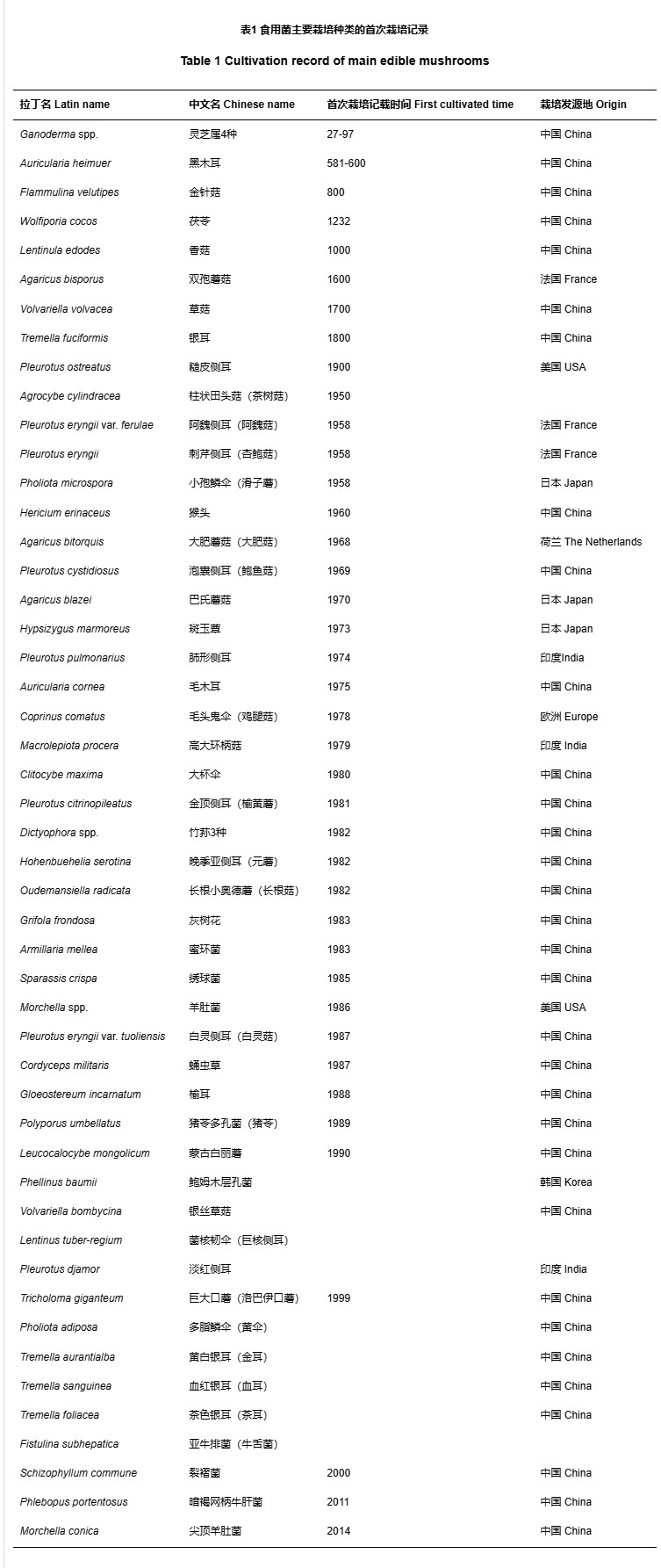
In ancient times, the utilization of edible mushrooms by human beings came entirely from the collection of wild environment. After thousands of years of careful observation of the morphology, habitat and habits of edible mushrooms, human beings began to domesticate and cultivate edible mushrooms, and as of 2004, 200 species could be cultivated experimentally and 100 species could be cultivated or cultured artificially (Chang & Miles 2004), with the addition of the spiky morel mushroom (Du Xihui et al. 2014) and the dark-brown reticulated boletus (Yang Cao et al. 2011) in recent years. About 60 species are commercially cultivated, and 10 species are commercially cultivated on a large scale (Chang & Miles 2004). Of the 50 species reported to have been first cultivated in captivity, most of the earliest cultivation records are in China (Table 1).
The vast majority of artificially cultivated species are wood-rotting fungi, while a few are grass-rotting fungi, soil-forming fungi and insect-forming fungi. Almost all species cultivated on a commercial scale are wood-rotting fungi and grass-rotting fungi.
Although China has a rich variety of cultivated species, the main output still comes from wood-rotting fungi, and in 2013, the output of only five species (types), including flat mushrooms (strigillum, white-yellow, and lung-shaped), shiitake mushrooms, black fungus, hairy fungus, and enoki mushrooms, amounted to 22,653,100 tons, accounting for 70% of the total output.
 Info@xtongfood.com
 +86 13858575598
 Tongjiang,Bazhong,Sichuan China
Copyright © 2024 XTONG Co.,Ltd. All Right Reserved. Designed & SEO by hoogege.com.cn Sitemap | XML
Welcome to text me on WhatsApp or send me an email to info@xintongfood.com

 HOME
HOME PRODUCTS
 ABOUT US
 BLOG
BLOG CONTACT US